
The University of Kansas is putting up advertisements for student jobs all year round, and the postings don’t seem to be coming down.
College students have often sought part-time or full-time employment while attending school to cover the cost of expenses such as tuition and textbooks. However, there has been concern in recent years that the number of students who work while in school is decreasing.
Sophomore Haley Demman had a job earlier in the 2022-2023 school year working at the Underground, a KU Dining facility on campus. Especially since the COVID-19 pandemic, KU Dining and other areas on campus have struggled to fill open positions, leading to limited hours of campus resources and even closings of various dining facilities.
“I quit my job because I decided to focus more of my time on schoolwork,” Demman said. “I’m glad I did with the stress of finals and the end of the semester coming up.”
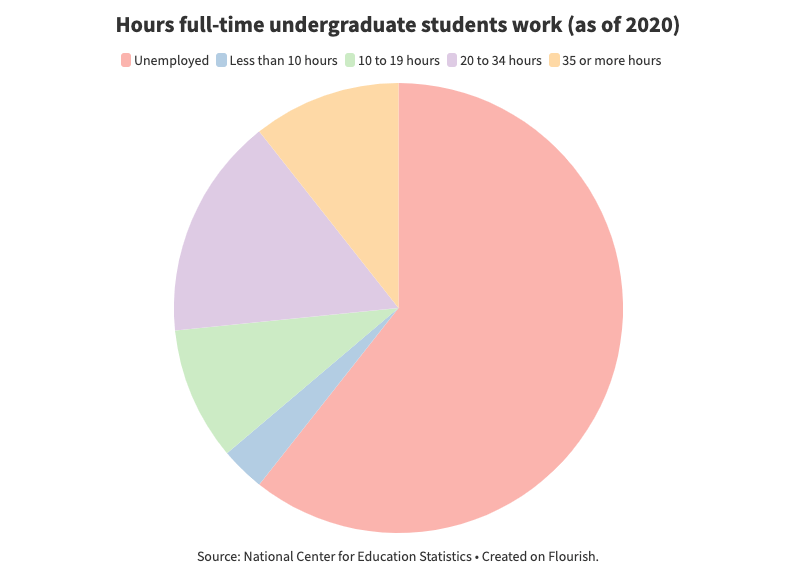
According to the Bureau of Labor Statistics in October 2022, if students are enrolled full-time in college, they are far less likely to be in the labor force than part-time students, at 42.4 percent versus 81 percent.
Some studies suggest that the proportion of college students who work while attending school has declined over the past few decades. There are several potential reasons for this trend, including, but not limited to, changes in the increased availability of financial aid and a shift in priorities among college students.
Students are spending more time learning career-based skills and end up wanting to find that in a college job, as well.
Ann Hartley is the Associate Director with employer recruiting with the University Career Center. Her main duties include building relationships with employers and promoting their opportunities to KU students, as well as supervising the Career Center Specialist staff, YES Tutoring and Kansas Work Study programs.
“Students now are more choosy about what they want to do,” Hartley said. “It depends on your own personal circumstances and whether you’re trying to build some experience to go into a certain kind of field. That internship experience is what’s going to open the door for you. That’s where you’re going to get your network.”
Sophomore journalism student Karen Morales is the social media marketing intern for the University Career Center and relates to this sentiment.
“I wanted this job to gain experience outside of the classroom setting,” Morales said. “It’s given me opportunities to connect with other people and learn more about my field going forward.”
Daniel Douglas, co-author of a 2019 Rutgers Education and Employment Research Center paper, said, “The more you work during your first year of college, the more you earn after college.” If this is the case, then why don’t all students work?
According to the KU Common Data Set from 2020, the average amount undergraduate students earned during the 2019-2020 school year for part-time on-campus work was $4,500. This includes the average student wage of $10.20 per hour by working 8.5 hours a week.
However, these numbers don’t express what student workers themselves feel.
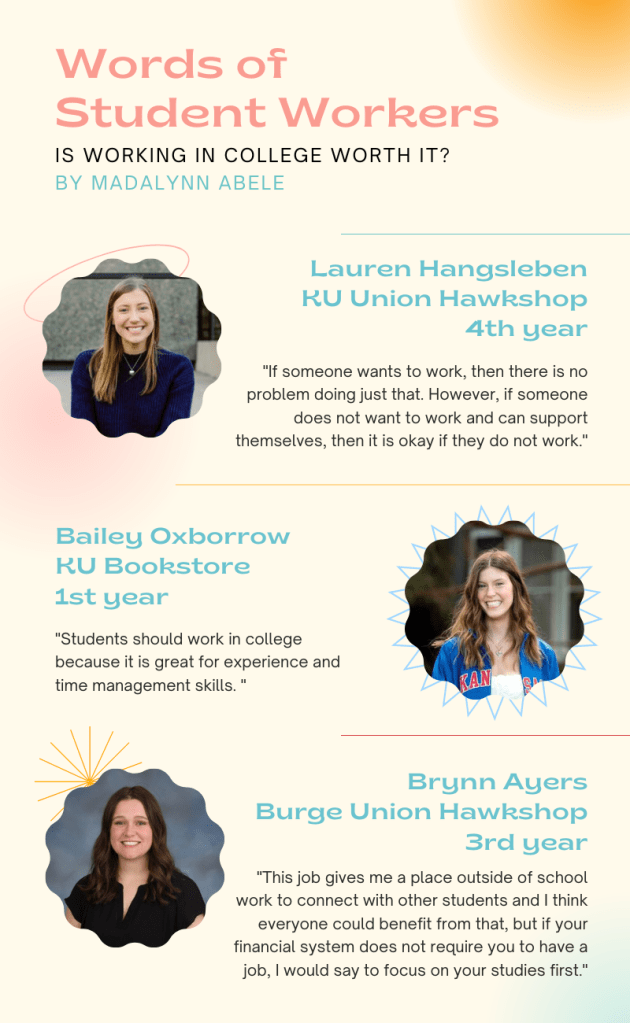
Senior Lauren Hangsleben works at the Hawk Shop at the Kansas Memorial Union and gets paid $10.50 an hour for 15 hours a week, higher than the school average.
“I would definitely like to get paid more, especially during the end of semester when students are trying to use all of their dining dollars,” Hangsleben said.
Anne Hartley also noticed the low pay for students by working on the hiring end of campus jobs.
“Especially at KU, some of our salaries were really low for students,” Hartley said. “That’s hard now in 2023 to have a really low paid job and expect to find people that are going to come when they can find something that pays better.”
Despite the limited pay, Hansleben still has never thought about leaving her job with the university.
“My bosses are really understanding of the fact that I am a student and have always been accommodating and helpful when it comes to making a schedule with times that I could manage,” she said.
Steve Rottinghaus is the career and outreach coordinator for the William Allen White School of Journalism and Mass Communications where his main duties include working alongside students seeking internships and employment. Every day he sees students taking skills learned in entry-level part-time jobs and introducing them to a more professional line of work.
“If you can communicate written, verbally, have great presentation skills, be persuasive in your speech, those are skills that are common across any industry,” Rottinghaus said. Whether the job a student works is at a Starbucks, as a social media assistant or in a hospital, showing future employers an ability to work as a team is a strong skill for a student to have, and KU will continue pushing the importance of student employment, no matter what area it is in.
Video Transcript:
REPORTER: The University of Kansas is putting up advertisements for student jobs all year round, and the postings don’t seem to be coming down.
HARTLEY: Sometimes when I post jobs to hire in here internally to the Career Center, I don’t see as many applicants as I might have seen in the past.
REPORTER: KU student Haley Demman is an example of a student who once worked for the university, but doesn’t anymore.
DEMMAN: I think it’s hard to balance everything, just because there’s school work, having a job, and then also balancing a social life in college is really hard, and I feel like you have to pick where your priorities are.
REPORTER: One of these such priorities is pay. College students are notoriously low income, so if the pay is low enough, it isn’t always appealing when there are other stressors.
MORALES: For a campus job, I think the pay is okay, but I wish I got paid more for the job, or the work that I do.
REPORTER: While pay is important, students are also in school to learn. No matter the type of job, from working in a Starbucks, as a social media assistant or in a hospital, showing future employers an ability to work as a team is a strong skill for a student to have, and KU will continue pushing the importance of student employment, no matter what area it is in.
 Madalynn Abele
Leave a comment